View-factor disk with oriented area element

View-factor fully visible

One method for computing diffuse global illumination is radiosity (Radiosity). The solution to the illumination problem is gained by bouncing light around all the surfaces in a scene until nothing changes anymore. To do this, one has to consider how much of the light arriving at one surface will be sent to another one. The proportion of the total light exchange is called view factor (sometimes form factor or configuration factor).

I once had to deal with a related problem, not radiosity, where I had to more or less compute the view factor of a differential surface patch (a point on a surface) and a disk. The point is located along the disk's normal, but rotated somewhat. This post will deal with the case, that disk is fully visible. You can find this and many other formulas at http://www.thermalradiation.net/, even with references on where they are from. Sadly, when I looked up the sources for the specific formulas, they were horribly described and nearly unreadable imho. So I plan to do a (hopefully) more easily understood derivation.

The quantity we want to compute is as follows:

FdA1,A2=A2cosβ1cosβ2dA2πr2F_{dA_1,A_2} = \int_{A_2}\frac{\cos\beta_1 \cos\beta_2 dA_2}{\pi r^2}

We have a differential area dA1dA_1 and an area A2A_2. We now integrate over A2A_2, and for every differential area dA2dA_2 on it, we connect it to dA1dA_1. The length of that connection is rr, the angle with the normal of dA1dA_1 is cosβ1\cos\beta_1 and the angle with the normal of dA2dA_2 is cosβ2\cos\beta_2. There are various ways to deal with that problem depending on the geometry involved. One way can be found in a paper by Sparrow ("A new and Simpler Formulation for Radiative Angle Factors",1963). The key insight is, that Stoke's theorem can be used to compute that area integral, meaning you can transform the integral over the area into one over the surface's contour. The result is the following:

FdA1,A2=l1C(z2z1)dy2(y2y1)dz22πd2+m1C(x2x1)dz2(z2z1)dx22πd2+n1C(y2y1)dx2(x2x1)dy22πd2\begin{aligned} F_{dA_1,A_2} &= l_1\oint_C \frac{(z_2-z_1)dy_2 - (y_2-y_1)dz_2}{2\pi d^2} \\&+ m_1\oint_C \frac{(x_2-x_1)dz_2 - (z_2-z_1)dx_2}{2\pi d^2} \\ &+ n_1\oint_C \frac{(y_2-y_1)dx_2 - (x_2-x_1)dy_2}{2\pi d^2} \end{aligned}

l1,m1,n1l_1, m_1, n_1 are the components of dA1dA_1's normal expressed in a given coordinate system with the x,y,z\mathbf{x}, \mathbf{y}, \mathbf{z} axes. Or, as worded in the paper, they are the directional cosines, the cosines of the angle between the normal and each axis (or in other words, their dot product). The C\oint_C notation means, that we need a closed boundary curve, meaning we end where we start. The other values are the coordinates, their index representing which surface they belong to. Since we only go over the surface A2A_2, only those coordinates vary. d2d^2 is the squared distance between two points, so it can be computed as:

d2=(x2x1)2+(y2y1)2+(z2z1)2d^2 = (x_2 - x_1)^2 + (y_2 - y_1)^2 + (z_2 - z_1)^2

We can now get to our problem. First, let's sketch the setup:

Basic setup

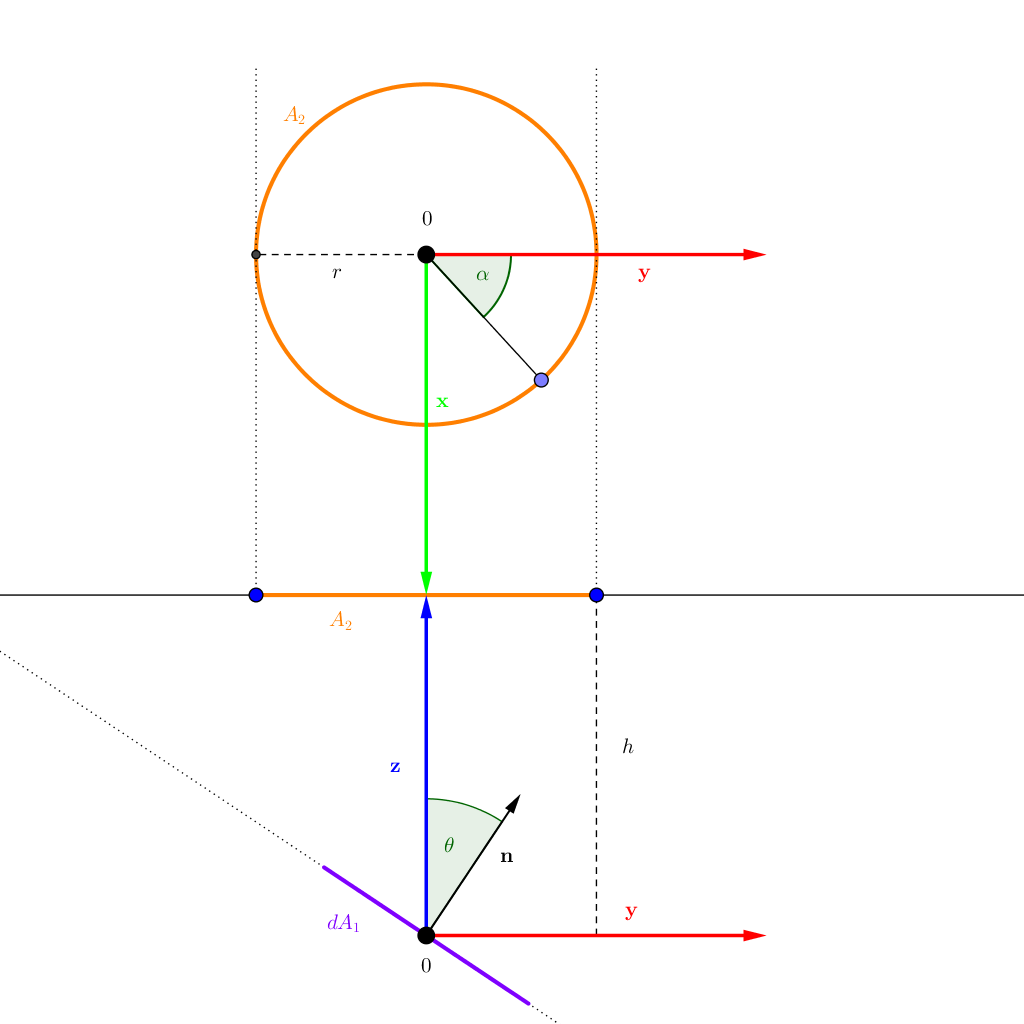
In this sketch, two views are included. Below the line in the middle is the yzyz plane. We are always free to choose a coordinate system best suited for our endeavor. Here we choose one, where our point is located in the origin. Its surface patch is oriented, such that its normal lies completely in the yzyz plane. The disk's normal point along the negative zz axis and is located directly on top of the point. As the surface patch already takes care of the orientation, the disk can be placed entirely in the xyxy plane, as shown in the top half of the image. The disk is located at z=hz=h and has a radius rr. The angle between the differential area's normal and the zz-axis (or the disk's negative normal) is θ\theta. The parameter we will use to describe the points on the circle is α\alpha, the orientation as shown. For a more 3D-ish view of the scene, have a look at http://www.thermalradiation.net/sectionb/B-13.html. Our case here corresponds to the first case on the site. I will also use the same identifiers, so that we will arrive at the same expressions at the end.

With that in mind, we can define all relevant values. Let's start with the directional cosines. Since our surface normal does not extend into the xx direction, they have an angle of π/2\pi /2 (9090^{\circ}) and therefore the cosine is 00. From the picture, we have the angle θ\theta between n\mathbf{n} and zz, so that cosine is cosθ\cos \theta. The last entry is between n\mathbf{n} and yy. The angle beween them is π2θ\frac{\pi}{2} - \theta. So we have cos(π2θ)=sinθ\cos (\frac{\pi}{2} - \theta) = \sin \theta.

l1=nx=0m1=ny=sinθn1=nz=cosθ\begin{aligned} l_1 &= \mathbf{n}\cdot\mathbf{x} = 0 \\ m_1 &= \mathbf{n}\cdot\mathbf{y} = \sin \theta \\ n_1 &= \mathbf{n}\cdot\mathbf{z} = \cos \theta \end{aligned}

Next up are the values for the first surface (the differential area). Due to our choice of coordinate system, the point on the surface lies in the origin, so we have

x1=0y1=0z1=0\begin{aligned} x_1 &= 0\\ y_1 &= 0 \\ z_1 &= 0 \end{aligned}

The last missing entries are the ones for the second area, or in this case, the area's contour and the squared distance. First, the disk is located at a constant zz value: hh. The disk's contour is a circle, so the usual description for a circle can be used.

x2=rsinαy2=rcosαz2=h\begin{aligned} x_2 &= r \sin \alpha \\ y_2 &= r \cos \alpha \\ z_2 &= h \end{aligned}

α\alpha varies from 00 to 2π2\pi for the whole circle. We could do only the half, since it's symmetric, but it doesn't matter much here. From that we can compute the differentials. For some function we have df=dfdxdxdf = \frac{df}{dx} dx, where dfdx\frac{df}{dx} is just the derivative with respect to dxdx. Here, the parameter is α\alpha, so the result is:

dx2=rcosαdαdy2=rsinαdαdz2=0\begin{aligned} dx_2 &= r \cos \alpha d\alpha\\ dy_2 &= -r \sin \alpha d\alpha \\ dz_2 &= 0 \end{aligned}

The squared distance:

d2=(rsinα0)2+(rcosα)2+(h0)2=r2sin2α+r2cos2α+h2=r2(sin2α+cos2α)+h2=r2+h2\begin{aligned} d^2 &= (r \sin \alpha-0)^2 + (r \cos \alpha)^2 + (h-0)^2 \\ &= r^2\sin^2\alpha + r^2\cos^2\alpha + h^2 \\ &= r^2(\sin^2\alpha + \cos^2\alpha) + h^2 \\ &= r^2 + h^2\end{aligned}

We can now plug this into the equation from before. For better readability, I'll do the terms one by one.

l1C(z2z1)dy2(y2y1)dz22πd2=0C(z2z1)dy2(y2y1)dz22πr2=0\begin{aligned} l_1\oint_C \frac{(z_2-z_1)dy_2 - (y_2-y_1)dz_2}{2\pi d^2} &= 0\oint_C \frac{(z_2-z_1)dy_2 - (y_2-y_1)dz_2}{2\pi r^2} \\ &= 0 \end{aligned}

m1C(x2x1)dz2(z2z1)dx22πd2=sinθ2π02πrsinα0hrcosαdαr2+h2=hrsinθ2π(r2+h2)02πcosαdα=hrsinθ2π(r2+h2)0=0\begin{aligned}m_1\oint_C \frac{(x_2-x_1)dz_2 - (z_2-z_1)dx_2}{2\pi d^2} &= \frac{\sin \theta}{2\pi} \int_0^{2\pi} \frac{r\sin \alpha * 0 - hr\cos \alpha d\alpha}{r^2 + h^2 } \\ &= -\frac{hr\sin \theta}{2\pi(r^2+h^2)} \int_0^{2\pi} \cos \alpha d\alpha \\ &=-\frac{hr\sin \theta}{2\pi(r^2+h^2)} * 0 \\ &= 0\end{aligned}

n1C(y2y1)dx2(x2x1)dy22πd2=cosθ2π02πrcosαrcosαdαrsinα(rsinα)dαr2+h2=cosθ2π(r2+h2)02πr2cos2α+r2sin2αdα=r2cosθ2π(r2+h2)02πcos2α+sin2αdα=r2cosθ2π(r2+h2)02π1dα=r2cosθ2π(r2+h2)2π=r2r2+h2cosθ\begin{aligned} n_1\oint_C \frac{(y_2-y_1)dx_2 - (x_2-x_1)dy_2}{2\pi d^2} &= \frac{\cos \theta}{2\pi} \int_0^{2\pi} \frac{r\cos \alpha r\cos \alpha d\alpha - r\sin \alpha (-r\sin \alpha)d\alpha}{r^2 + h^2 } \\ &= \frac{\cos \theta}{2\pi(r^2+h^2)} \int_0^{2\pi} r^2\cos^2 \alpha + r^2\sin^2 \alpha d\alpha \\ &= \frac{r^2\cos \theta}{2\pi(r^2+h^2)} \int_0^{2\pi} \cos^2 \alpha + \sin^2 \alpha d\alpha \\ &= \frac{r^2\cos \theta}{2\pi(r^2+h^2)} \int_0^{2\pi} 1 d\alpha \\ &= \frac{r^2\cos \theta}{2\pi(r^2+h^2)} 2\pi \\ &= \frac{r^2}{r^2+h^2}\cos \theta\end{aligned}

As this last one is the only not-null entry we finally have:

FdA1,A2=r2r2+h2cosθF_{dA_1,A_2} = \frac{r^2}{r^2+h^2}\cos \theta

A slight bit of reformulation can be done. We introduce the variable H=hrH = \frac{h}{r}. Then we can rearrange a part of the result:

r2r2+h2=r2r2+h2r2r2=r2r2r2+h2r2=11+h2r2=11+H2\begin{aligned} \frac{r^2}{r^2+h^2} &= \frac{r^2}{r^2+h^2} *\frac{r^2}{r^2} \\ &= \frac{\frac{r^2}{r^2}}{\frac{r^2+h^2}{r^2}}\\ &= \frac{1}{1+ \frac{h^2}{r^2}} \\ &=\frac{1}{1 +H^2} \end{aligned}

With that we get the final result in the same form as in the reference http://www.thermalradiation.net/sectionb/B-13.html:

FdA1,A2=11+H2cosθF_{dA_1,A_2} = \frac{1}{1 +H^2}\cos \theta

Next post we will incorporate the fact, that some parts of the disks may connect with our surface from behind. They have to be removed from the calculation, which complicates the whole thing a bit.

View-factor partially visible

We want to compute the view factor of a disk and an oriented differential area located along the disk's normal. Before, we assumed all of the disk to be visible from our surface. But if our surface is rotated enough, the infinite plane it lies on intersects the disk. The cut off part is then behind the surface, so there is no radiation transfer. We will now handle that case. As before, we will derive the formula given in http://www.thermalradiation.net/sectionb/B-13.html. First a sketch of the updated setup:

Basic setup

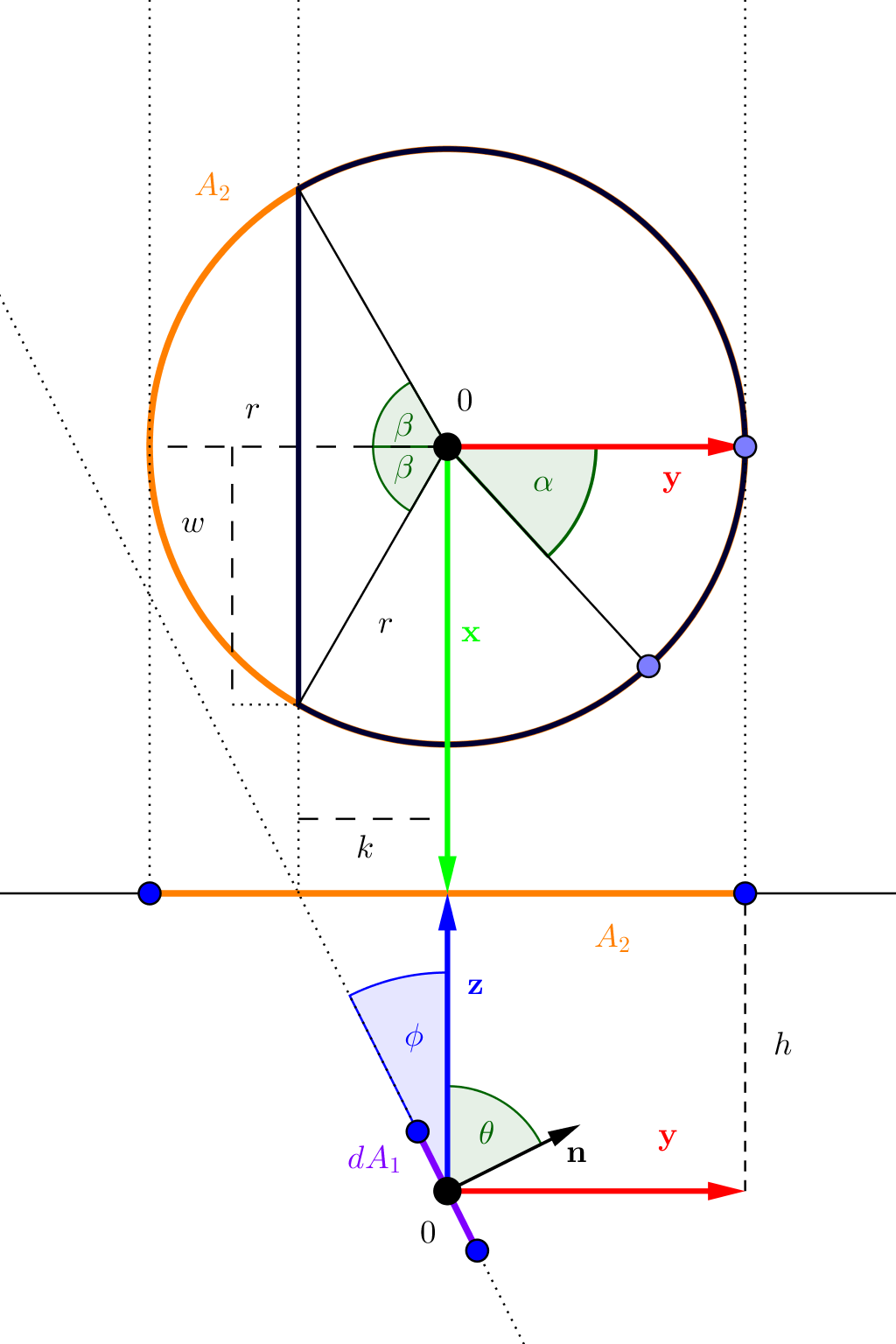
The update from the last post is that we cut off the part of the disk behind the plane. The resulting shape is outlined in the very dark blue.

We will now find the condition for when the disk is fully visible. From the image, we can see that it is fully visible, if kk is larger than the disk's radius rr. Since the normal is perpendicular to the plane, we have ϕ=π2θ \phi = \frac{\pi}{2} - \theta. Computing the tangent yields:

tanϕ=tan(π2θ)=cotθ=kh \begin{aligned} \tan \phi &= \tan (\frac{\pi}{2} - \theta) \\ &= \cot \theta \\ &= \frac{k}{h} \end{aligned}

And following from that

k=hcotθk = h\cot \theta

For the visibility condition:

rkrhcotθrhcotθcot1(rh)θcot1(1H)θ\begin{aligned} r \leq k \\r \leq h\cot \theta \\ \frac{r}{h} \leq \cot \theta \\ \cot^{-1}(\frac{r}{h}) \geq \theta \\ \cot^{-1}(\frac{1}{H}) \geq \theta \end{aligned}

The last line uses the definition H=hrH = \frac{h}{r}. The reversal of the inequality sign comes from the fact, that the inverse cotangent function is monotonically decreasing. This is the same condition as given in the reference. If it holds, we can apply the previous post's reasoning and are finished.

For the next steps we will compute β\beta.

cosβ=kr=hcotθr=Hcotθβ=cos1(Hcotθ) \begin{aligned} \cos \beta &= \frac{k}{r} \\ &= \frac{h\cot \theta}{r}\\ &= H\cot \theta \\ \beta &= \cos^{-1}(H\cot \theta) \end{aligned}

Since we will need it later, we can derive another useful expression with the identity sin(cos1x)=1x2\sin(\cos^{-1}x) = \sqrt{1-x^2}

sinβ=sincos1(Hcotθ)=1H2cot2θ=X \begin{aligned} \sin \beta &= \sin \cos^{-1}(H\cot \theta) \\ &= \sqrt{1-H^2\cot^2\theta} \\ &= X \end{aligned}

We will now proceed with the actual computation. It will be split into two parts, since the contour can be decomposed into two parts: A circle segment and a straight line.

Circle segment

Pretty much all the setup is the same as in the last part, so I will refer to that for more information. The only difference is the interval over which to integrate. Before we had the full circle in [0,π][0,\pi]. Now a part is missing. The new interval goes up to πβ\pi - \beta and starts at that value in negative (πβ)=π+β-(\pi - \beta) = -\pi + \beta. One simplification can be done. Since the disk is symmetric, we could just integrate over half the disk and double the result. Doesn't matter in the end, just a bit less to write. We will now compute the values from before with the new bounds.

hrsinθ2π(r2+h2)20πβcosαdα=hrsinθπ(r2+h2)0πβcosαdα=hrsinθπ(r2+h2)(sin(πβ)sin0)=hrsinθπ(r2+h2)sin(β)=hrsinθπ(r2+h2)X=hrXsinθπ(r2+h2)r2r2=HXsinθπ(1+H2) \begin{aligned} -\frac{hr\sin \theta}{2\pi(r^2+h^2)}*2 \int_0^{\pi - \beta} \cos \alpha d\alpha &= -\frac{hr\sin \theta}{\pi(r^2+h^2)}\int_0^{\pi - \beta} \cos \alpha d\alpha \\ &= -\frac{hr\sin \theta}{\pi(r^2+h^2)} (\sin(\pi - \beta) - \sin 0)\\ &= -\frac{hr\sin \theta}{\pi(r^2+h^2)}\sin(\beta) \\ &= -\frac{hr\sin \theta}{\pi(r^2+h^2)}X \\ &= -\frac{hrX\sin \theta}{\pi(r^2+h^2)} * \frac{r^2}{r^2}\\ &= -\frac{HX\sin \theta}{\pi(1+ H^2)} \end{aligned}

Then the second term:

r2cosθ2π(r2+h2)20πβ1dα=r2cosθπ(r2+h2)0πβ1dα=r2cosθπ(r2+h2)(πβ)=r2cosθπ(r2+h2)(πcos1(Hcotθ))=cosθπ(1+H2)(πcos1(Hcotθ)) \begin{aligned} \frac{r^2\cos \theta}{2\pi(r^2+h^2)}*2 \int_0^{\pi - \beta} 1 d\alpha &= \frac{r^2\cos \theta}{\pi(r^2+h^2)} \int_0^{\pi - \beta} 1 d\alpha \\ &= \frac{r^2\cos \theta}{\pi(r^2+h^2)} (\pi - \beta) \\ &= \frac{r^2\cos \theta}{\pi(r^2+h^2)}(\pi - \cos^{-1}(H\cot \theta))\\ &= \frac{\cos \theta}{\pi(1 + H^2)}(\pi - \cos^{-1}(H\cot \theta)) \end{aligned}

Line segment

The second contour segment is a line. We have computed a few values before:

l1=0m1=sinθn1=cosθx1=0y1=0z1=0 \begin{aligned} l_1 &= 0\\ m_1 &= \sin \theta \\ n_1 &= \cos \theta \\ x_1 &= 0\\ y_1 &= 0 \\ z_1 &= 0 \end{aligned}

From our sketch we can see, that the line is constant in zz and yy direction and only varies in xx. Instead of computing some line parametrization, we will just let x2x_2 vary from the line's start point to its endpoint. As before we will integrate over one half of the line and multiply the result by 22. The half length of the line is given by ww in the sketch. We have to be careful not to change direction going around the contour. To comply with the winding direction of α\alpha, we will vary the line from ww to 00. Now on to compute ww:

sinβ=wrX=wrw=rX \begin{aligned} \sin \beta &= \frac{w}{r} \\ X &= \frac{w}{r} \\ w &= rX \end{aligned}

To compile all missing values:

x2y2=k=hcotθz2=h \begin{aligned} x_2\\ y_2 &= -k = -h\cot \theta \\ z_2 &= h \end{aligned}

d2=x22+y22+z22=x22+h2cot2θ+h2d^2 = x_2^2 + y_2^2 + z_2^2 = x_2^2 + h^2\cot^2\theta + h^2

dx2dy2=0dz2=0 \begin{aligned} dx_2\\ dy_2 &= 0 \\ dz_2 &= 0 \end{aligned}

In the following, we will use 1+cot2θ=csc2θ=1sin2θ1+\cot^2 \theta = \csc^2 \theta = \frac{1}{\sin^2 \theta} a few times. With that we also have 1+cot2θ=1sinθ\sqrt{1+\cot^2\theta} = \frac{1}{\sin \theta}. Also, just as a heads up, I will not go into the detail of the final explicit integration in each formula, as those can be acquired either from consulting something like WolframAlpha or integration tables. Just one reminder: tan1(0)=0\tan^{-1}(0) = 0. We have to compute the following expression:

l1C(z2z1)dy2(y2y1)dz22πd2+m1C(x2x1)dz2(z2z1)dx22πd2+n1C(y2y1)dx2(x2x1)dy22πd2\begin{aligned} &l_1\oint_C \frac{(z_2-z_1)dy_2 - (y_2-y_1)dz_2}{2\pi d^2} \\ &+ m_1\oint_C \frac{(x_2-x_1)dz_2 - (z_2-z_1)dx_2}{2\pi d^2} \\ &+ n_1\oint_C \frac{(y_2-y_1)dx_2 - (x_2-x_1)dy_2}{2\pi d^2} \end{aligned}

The first term is 00, since l1=0l_1=0. Now on to solve the two remaining ones, keeping in mind the doubling of the result with half the line and the direction.

m1C(x2x1)dz2(z2z1)dx22πd2=sinθ2π2rX0(x20)0(h0)dx2x2+h2cot2θ+h2=sinθπrX0hdx2x2+h2cot2θ+h2=hsinθπ0rXdx2x2+h2cot2θ+h2=hsinθπ0rXdx2x2+h2cot2θ+h2=hsinθπtan1(x2h1+cot2θ)h1+cot2θ0rX=hsinθπtan1(rXh1+cot2θ)h1+cot2θ=sinθπtan1(rhX1sinθ)1sinθ=sin2θπtan1(1HXsinθ)=sin2θπtan1(XsinθH) \begin{aligned}m_1\oint_C \frac{(x_2-x_1)dz_2 - (z_2-z_1)dx_2}{2\pi d^2} &= \frac{\sin \theta}{2\pi} * 2\int_{rX}^0 \frac{(x_2- 0)*0 - (h-0)dx_2}{x^2 + h^2\cot^2\theta +h^2} \\ &= \frac{\sin \theta}{\pi}\int_{rX}^0 \frac{- hdx_2}{x^2 + h^2\cot^2\theta +h^2} \\ &=\frac{h\sin \theta}{\pi}-\int_{0}^{rX} \frac{-dx_2}{x^2 + h^2\cot^2\theta +h^2} \\ &= \frac{h\sin \theta}{\pi}\int_{0}^{rX} \frac{dx_2}{x^2 + h^2\cot^2\theta +h^2} \\ &= \frac{h\sin \theta}{\pi}\frac{\tan^{-1}(\frac{x_2}{h\sqrt{1 + \cot^2\theta}})}{h\sqrt{1 + \cot^2\theta}}\rVert_0^{rX} \\ &= \frac{h\sin \theta}{\pi}\frac{\tan^{-1}(\frac{rX}{h\sqrt{1 + \cot^2\theta}})}{h\sqrt{1 + \cot^2\theta}} \\ &= \frac{\sin \theta}{\pi}\frac{\tan^{-1}(\frac{r}{h}\frac{X}{\frac{1}{\sin\theta}})}{\frac{1}{\sin \theta}} \\ &= \frac{\sin^2 \theta}{\pi}\tan^{-1}(\frac{1}{H}X\sin \theta) \\ &= \frac{\sin^2 \theta}{\pi}\tan^{-1}(\frac{X\sin \theta}{H}) \end{aligned}

Nearly done! Only one more to go! We will do some of the initial steps from the last one again in one go. Also, since there is a term cotθ=cosθsinθ\cot\theta = \frac{\cos\theta}{\sin\theta} we do some rearranging.

n1C(y2y1)dx2(x2x1)dy22πd2=cosθ2π2rX0(hcotθ0)dx2(x20)0x2+h2cot2θ+h2=hcosθπ0rXcotθdx2x2+h2cot2θ+h2=hcosθcotθπ0rXdx2x2+h2(1+cot2θ)=hcosθcotθπ0rXdx2x2+h2(1sin2θ)=hcosθcotθπ0rXdx2x2+h2(1sin2θ)sin2θsin2θ=hcosθcosθsinθπ0rXdx2sin2θx2+h2=hcos2θsinθπ0rXdx2sin2θx2+h2=hcos2θsinθπ1sinθtan1(rXsinθh)h=cos2θπtan1(XsinθH) \begin{aligned} n_1\oint_C \frac{(y_2-y_1)dx_2 - (x_2-x_1)dy_2}{2\pi d^2} &= \frac{\cos\theta}{2\pi}*2\int_{rX}^0 \frac{(-h\cot\theta -0)dx_2 - (x_2-0)*0}{x^2 + h^2\cot^2\theta +h^2}\\ &= \frac{h\cos\theta}{\pi}\int_{0}^{rX} \frac{\cot\theta dx_2}{x^2 + h^2\cot^2\theta +h^2}\\ &= \frac{h\cos\theta\cot\theta}{\pi}\int_{0}^{rX} \frac{dx_2}{x^2 + h^2(1+\cot^2\theta)}\\ &= \frac{h\cos\theta\cot\theta}{\pi}\int_{0}^{rX} \frac{dx_2}{x^2 + h^2(\frac{1}{\sin^2\theta})}\\ &= \frac{h\cos\theta\cot\theta}{\pi}\int_{0}^{rX} \frac{dx_2}{x^2 + h^2(\frac{1}{\sin^2\theta})}\frac{\sin^2\theta}{\sin^2\theta}\\ &= \frac{h\cos\theta\cos\theta\sin\theta}{\pi}\int_{0}^{rX} \frac{dx_2}{\sin^2\theta x^2 + h^2}\\ &= \frac{h\cos^2\theta \sin\theta}{\pi}\int_{0}^{rX} \frac{dx_2}{\sin^2\theta x^2 + h^2}\\ &= \frac{h\cos^2\theta \sin\theta}{\pi}\frac{\frac{1}{\sin \theta} \tan^{-1}(\frac{rX\sin \theta}{h})}{h}\\ &= \frac{\cos^2\theta }{\pi}\tan^{-1}(\frac{X\sin \theta}{H})\\ \end{aligned}

Wohoo! We can add the two results for the line:

sin2θπtan1(XsinθH)+cos2θπtan1(XsinθH)=1π(cos2θ+sin2θ)tan1(XsinθH)=1πtan1(XsinθH) \begin{aligned} \frac{\sin^2 \theta}{\pi}\tan^{-1}(\frac{X\sin \theta}{H}) + \frac{\cos^2\theta }{\pi}\tan^{-1}(\frac{X\sin \theta}{H}) &= \frac{1}{\pi}(cos^2\theta + \sin^2\theta) \tan^{-1}(\frac{X\sin \theta}{H}) \\ &=\frac{1}{\pi}\tan^{-1}(\frac{X\sin \theta}{H}) \end{aligned}

End result

The very last step now is to add the results for the circle segment and the line, which will result in the expression given in http://www.thermalradiation.net/sectionb/B-13.html:

FdA1,A2=HXsinθπ(1+H2)+cosθπ(1+H2)(πcos1(Hcotθ))+1πtan1(XsinθH)\begin{aligned} F_{dA_1,A_2} &= -\frac{HX\sin \theta}{\pi(1+ H^2)} + \frac{\cos \theta}{\pi(1 + H^2)}(\pi - \cos^{-1}(H\cot \theta)) + \frac{1}{\pi}\tan^{-1}(\frac{X\sin \theta}{H}) \end{aligned}